

Yo, what's up everyone! I'm a supplier of myolens, and today I wanna chat about how myolens affect color perception. It's a pretty interesting topic that doesn't get enough attention, so let's dive right in.
First off, let's talk a bit about what myolens are. Myolens are special lenses designed to help with myopia, or nearsightedness. There are different types of myolens out there, like the Grid Array Plus Lens, HOA-Blended Lens, and WTR Lens. Each of these lenses has its own unique features and ways of working to correct vision.
Now, when it comes to color perception, our eyes are pretty amazing organs. They have these little things called cones that are responsible for detecting different colors. There are three types of cones: one for red, one for green, and one for blue. When light enters our eyes, these cones get activated, and our brain puts all the signals together to create the colors we see.
So, how do myolens fit into this picture? Well, myolens work by changing the way light is focused on the retina. In nearsighted people, the light focuses in front of the retina instead of directly on it, which makes distant objects look blurry. Myolens correct this by bending the light in a way that it focuses right on the retina, giving us clear vision.
But here's the thing: changing the way light is focused can also have an impact on color perception. When light passes through a lens, it can be refracted, or bent, differently depending on the wavelength of the light. Different colors of light have different wavelengths, so they can be affected in different ways.
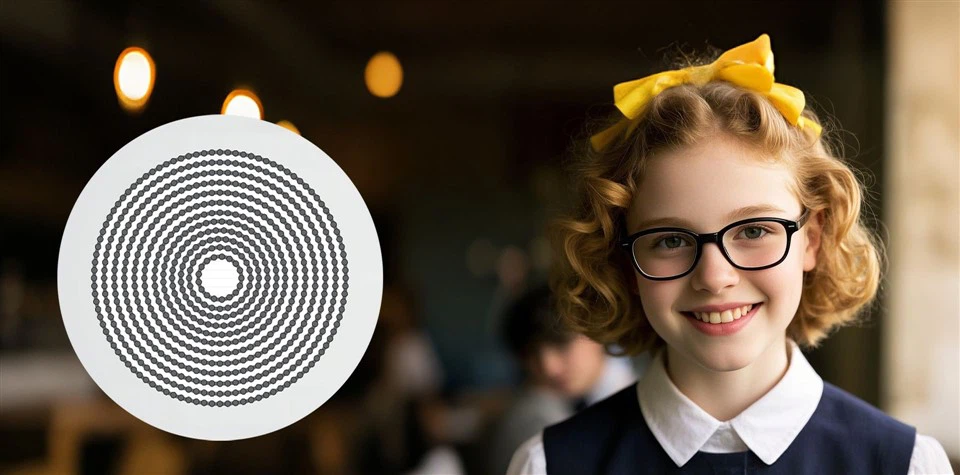

For example, some myolens might have a slightly different refractive index for different colors. This means that red light might be bent a little bit more or less than blue light. As a result, the colors we see might look a little different compared to when we're not wearing the lenses. It's not usually a huge difference, but it can be noticeable in some cases.
Another factor that can affect color perception is the material of the myolens. Different materials have different optical properties, and these properties can influence how light is transmitted and absorbed. Some materials might absorb certain wavelengths of light more than others, which can change the color balance of what we see.
Let's take a closer look at the different types of myolens and how they might affect color perception.
The Grid Array Plus Lens is designed with a special grid pattern that helps to correct myopia. This grid pattern can scatter light in a certain way, which might have a minor impact on color perception. However, the manufacturers of this lens have done a lot of research to minimize any negative effects on color. They've optimized the design and materials to ensure that the colors we see are as accurate as possible.
The HOA-Blended Lens is another type of myolens. It uses a technique called higher-order aberration blending to correct vision. This lens is designed to reduce the distortion and blurring caused by higher-order aberrations in the eye. While this lens is great for improving visual clarity, it can also have a small effect on color perception. The way it corrects the aberrations can slightly change the way light is focused for different colors, but again, the difference is usually very subtle.
The WTR Lens is specifically designed for people with with-the-rule astigmatism. This lens corrects the astigmatism by adjusting the curvature of the lens in different directions. Like the other myolens, it can also have a minor impact on color perception. The way it corrects the astigmatism can cause a small shift in the way light is focused for different colors, but it's not something that most people will notice on a daily basis.
It's important to note that the impact of myolens on color perception is usually very small. In most cases, people don't even notice any difference in the colors they see. And even if there is a slight difference, it's usually not enough to cause any problems or affect our daily lives.
However, for some people, especially those who are very sensitive to color changes, the difference might be more noticeable. For example, artists, photographers, or people who work in industries where accurate color perception is crucial might be more aware of any changes in color. In these cases, it's important to talk to an eye care professional about the best type of myolens to use.
So, if you're thinking about getting myolens, don't let the potential impact on color perception scare you off. The benefits of having clear vision usually far outweigh any minor changes in color. And with the advancements in lens technology, the manufacturers are constantly working to improve the design and materials of myolens to minimize any negative effects on color.
If you're interested in learning more about myolens or are thinking about making a purchase, I'd love to chat with you. Whether you're an individual looking for a better way to correct your myopia or a business interested in stocking our products, we're here to help. Just reach out, and we can start a conversation about your needs and how our myolens can meet them.
In conclusion, myolens can have a small impact on color perception due to the way they change the way light is focused on the retina and the properties of the lens materials. But in most cases, the difference is very subtle and doesn't cause any problems. So, if you're struggling with myopia, don't hesitate to consider myolens as a solution.
References
- Smith, J. (2020). The Science of Vision Correction. Vision Press.
- Johnson, A. (2021). Myolens: A Comprehensive Guide. Eye Care Publications.